Wednesday, 1 June 2011

Drumstick leaves / Munagaaku Rasam

There are lots of nutritional values in drumstick leaves. Drumstick leaves have Seven times more vitamin C than oranges to fight against many illnesses including cold and flu as it helps in congestion. and four times more vitamin A than in carrots to protect against our eye diseases, skin diseases, and heart diseases. It has four times more calcium than present in milk to build strong bones and teeth. It is three times more rich in potassium than bananas,which is essential for the functioning of the brain and nerves.

Few other benefits of Drumstick:
- The leaves have twice the amount of the protein than in milk and almost equal amounts of protein present in eggs.
- Medicinal uses
- The seeds are generally used to clean and purify dirty or hazy drinking water. It is pounded and wrapped in a muslin cloth, and dipped in jars or containers that has water in it.
-The bark of the drumstick plant contains a gum that is used for the treatment of various stomach ailments such as :---
- Seeds are found to be highly beneficial as they helps a person when there is loss of appetite, colic pain and flatulence ,it removes gas from our stomatch.
- A hot infusion of the leaves provides relief in the case of skin diseases.The same kind of infusion can be bought to use in fevers to reduce temperature.

Ingredients:
Toor Daal – ½ cup
Drumstick leaves – 1 cup
Tomato – 2 large
Rasam powder (any variety)
Turmeric
Salt
Tamarind – ½ lemon size
For Seasoning
Oil – 1 tbsp
Garlic pods – 2 to 3
Mustard + Cumin – 1 tsp
Curry leaves
Coriander
Red Chili – 1 or 2

Drumstick leaves and toor daal
Method:
Wash and pressure cook / boil toor dall, drumstick leaves and tomatoes by adding pinch of turmeric. When the daal mixture is still hot add tamarind and salt and pulse it slightly or mash it with wooden masher. Heat a sauce pan with oil and do the seasonings by adding red chilli, pounded garlic pods, curry leaves, mustard and cumin. Add the daal mixture to the seasoning and add rasam powder and chopped coriander and bring the rasam to boil.

Munagaaku rasam
Serve warm with rice or can be served on its own as soup.

Wednesday, 25 May 2011

Boiled peanuts

Peanut as most of us do not know came from a legume family (and not in the nut family) just like a bean or pea. The nuts originate from the stems, but are pushed into the ground by the plant at an early stage, and it is underground that they mature. These can be eaten as raw when they are fresh or dry. Also can be eaten in different forms like boiled, roasted, powder form or butter form.

Fresh peanuts. I call them as edible corals. Aren't they ?

Let us see few of their benefits:-
Whole peanuts contains high amount of protein, which makes it a preferred diet of those people engaged in body-building and those people who are weak and underweight. The raw peanut butter with crushed skin contains much higher amounts of nutrient than refined "nut-only" butter.
Peanut is a good source of Coenzyme Q10 which protects the heart during the period of lack of oxygen example high altitudes and clogged arteries.
Peanuts contain high concentrations of antioxidant polyphenols, primarily a compound called p-coumaric acid. Roasting peanuts increases its p-coumaric acid levels, boosting it overall antioxidant content by as much as 22%. Roasted peanuts rival the antioxidant content of blackberries and strawberries, and are far richer in antioxidants than apples, carrots or beets.
Unsalted peanuts are good for your arteries. One quarter cup of peanuts contains as much monunsaturated fat as a tablespoon of olive oil. Monounsaturated fats have been shown to lower blood cholesterol.
Peanuts' high niacin content helps in the recovery of cell damage provides protection against Alzheimer's disease and age-related cognitive problem.
Peanut contain vitamin E, a powerful antioxidant that is shown to significantly reduce the risk of cancer and cardiovascular diseases.
Peanut contain iron which is essential for the correct functioning of red blood cells.
Peanut is rich in calcium which helps promotes healthy bones.
Peanut has higher bioflavonoid resveratrol content than grapes. This bioflavonoid is believed to improve blood flow in the brain by as much as 30%, thus greatly reducing the risk of stroke. Study showed that by adding even small amounts of peanut products to the diet can reduce LDL (bad) cholesterol by 14%.
Peanuts' fiber content helps lower the risk of colon cancer, an ounce of peanuts contains 2 grams of fiber.

To boil the peanuts, first soak the fresh peanuts in water for about 30 minutes or so and wash them thoroughly. Add some salt (about 1 tsp for 4 cups of peanuts) and boil them. If you are pressure cooking them , then use less water and if not use more water. Pressure cook them until one whistle or if you are cooking normally, then cook until they are just done. The doneness can be checked by opening one peanut shell and press the peanut between your fingures. If it is soft enough to split, then it is done. Do not over cook them.

Boiled peanuts with garam garam chai

Friday, 20 May 2011

Vankaya Matikkayala pullakoora (Egg plant with cluster beans)

This is another Rayalaseema recipe with the combination of egg plant and cluster beans. When compared to other curries, these recipes require less oil and also do not require any expertise to achieve the heavenly taste.


Vankaya matikkayala pullkoora

In few regions of Andhra, cluster beans are called as matikkayalu and at few regions, they are called as goruchikkudu. These beans come in clusters and hence the name cluster beans.

Ingredients:

Egg plants – Small variety – 4-5
Cluster beans - about 100 grams remove the head and tail parts and break into 2 pieces only
Onion – 1 large cut into medium chunks
Tamarind - lemon size
Turmeric – ¼ tsp
Salt
For seasoning:
Garlic - 3-4 pods
Curry leaves
Mustard + Cumin - 1 tsp
Bengal gram / Chana daal - 1 tsp
Oil

Egg plant, Cluster beans, Tamarind, green chilli

Method:
Heat a deep pan with 1 tsp of oil. When it is hot enough, add onion, stir for a minute, add cluster beans and stir for a minute or 2 and finally add egg plant and fry for another minute and cover with lid for 5 minutes. Remove the lid and sprinkle some water (about 30 – 50 ml) stir again, cover it and cook slowly under medium to low flame. In this way the veggies don’t get burned and also tastes good. Once the eggplant and cluster beans become tender, remove from the fire, add some salt (preferably rock salt) and mash roughly using wooden motor.

For seasoning: Heat oil in a small pan and when it is hot add Red chilli, chana daal (Bengal gram), pounded garlic, mustard, cumin and curry leaves one after the other and fry until the garlic changes into golden color.

Seasoning to add

Add the seasoning to the mashed stuff and mix every thing. Serve with hot rice.
Vankaya matikkayala pullakoora with rice and daal

Sunday, 15 May 2011

Cabbage Manchuria

This is a different variety of manchurian recipe using cabbage and yet retains the similar taste as the other manchurian varieties have.


Cabbage manchuria
Ingredients:
Cabbage chopped into thin strips – 3 cups
Corn Flour – 2 tbsp
Plain Flour – 3-4 tbsp
Chilli powder – ½ tsp
Salt
Cumin
Ginger - finely chopped – 1 tbsp
Garlic - finely chopped – 1 tbsp
Soya Sauce – 2 tbsp
Vinegar – 1 tbsp
Chilli Sauce – 1 tsp
Capsicum – 1 medium chopped
Onion – 1 medium chopped
Green chilli – 2-3 chopped
Carrot grated – 3 tbsp
Lettuce chopped into thin strips – ½ cup

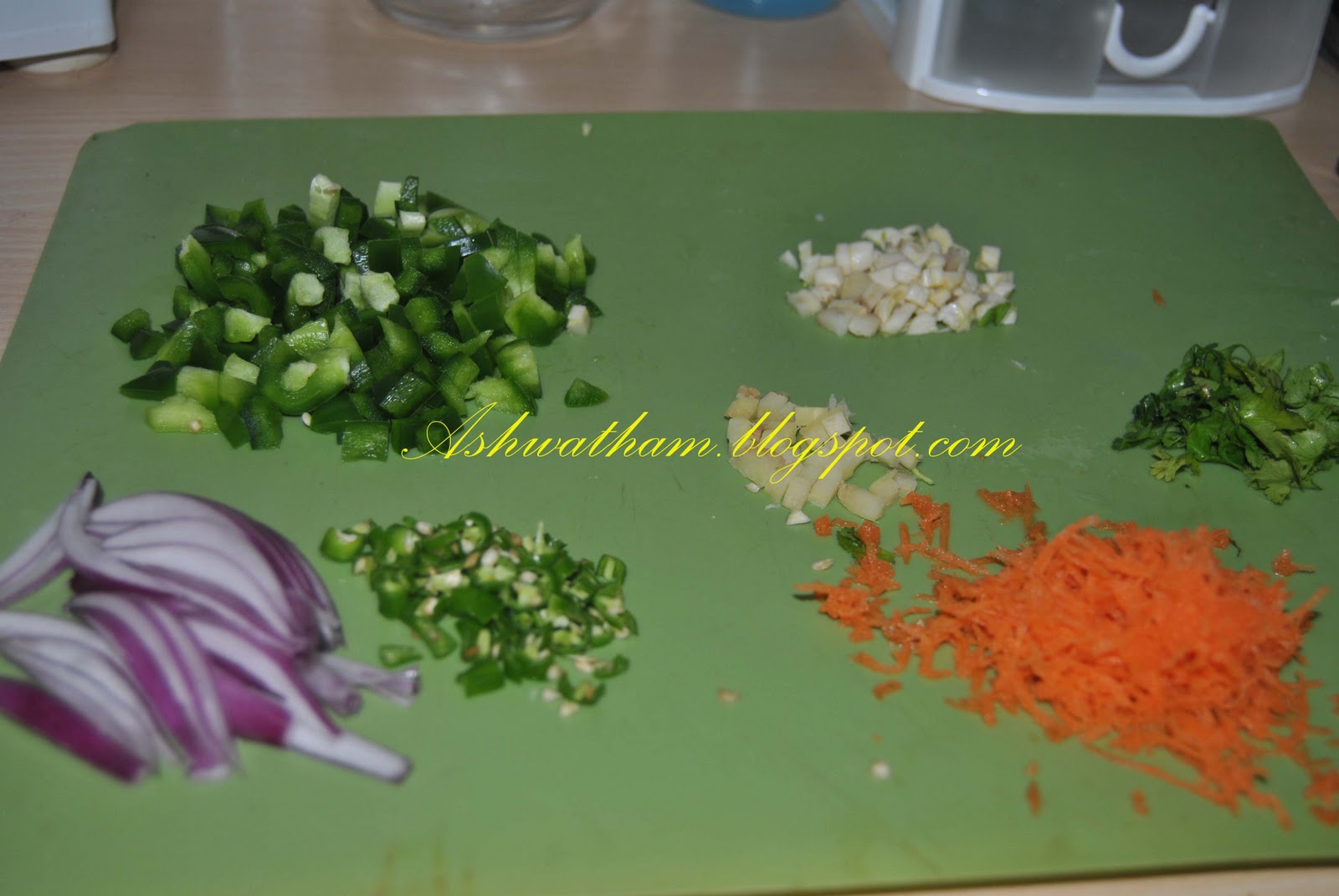
Capsicum, Garlic, Coriander, Carrot, green chili, ginger and onion

Method:

To the chopped cabbage add corn flour, plain flour, salt, chilli powder and cumin and add little bit of water just to bind the flours and cabbage together.


Heat a pan with oil to deep fry the cabbage mixture. When the oil is hot enough drop the cabbage mixture slowly in the form of thin strips. Fry until it is done, drain the excess oil and keep it separately.


Take another pan with 1-2 tbsp of oil. When it is hot add capsicum, green chilli, ginger and garlic. Sauté for a minute and then add the rest of the ingredients like carrot, onion, chilli sauce, soya sauce Vinegar, lettuce and stir once.


 Now add the fried cabbage and stir every thing and close the lid.


 Allow it to absord all the flavours and remove from the fire and serve it immediately.

Yummy yummy.....quick....

Wednesday, 11 May 2011

Jonnalu / Sorgham/ Jowar dosa

Jawar is grown and extensively used in Maharashtra, Karnataka, Madhya Pradesh, Andhra Pradesh, Gujarat, Uttar Pradesh and Tamilnadu in India. It is used for Roti or Bhakri.

Now a days it is a common problem that most of the middle aged people are suffering from diabeties. Most of them will be depending on the medicines instead of taking proper diet. The common thoughts are eating chapathi during nights might put a check for the diabetes. Rice has a tendency to increase the blood sugar levels very quickly which is not so good for diabetes. I thought to give a go using protein and fibre rich
jawar instead of rice.

You can find more benefits of Jowar here http://en.wikipedia.org/wiki/Jowar

Ingredients:

Jowar – 3 cups
Rice – 1 cup
Urad daal / Black gram – 1 cup
Fenugreek seeds – 1 tsp

Urad daal and Jawar

Method:

Soak jowar, rice and urad daal + Fenugreek seeds together for atleast 6 hours or even over night. Grind them into paste like the normal dosa batter. Add salt and allow the batter to ferment for at least 8 hours. When it is fully fermented , prepare dosa as normal. You can find more dosa recipes here.

Jawar dosa served with peanut chutney

Note: You can also avoid the rice completely and use 4 cups of Jowar instead of 3.

Monday, 9 May 2011

Punugulu, Fritters made with dosa batter

These fritters are prepared with leftover idli or dosa batter. I normally prepare them when the batter is not  enough for the whole family or at least not enough for kids.This recipe is quick and easy to prepare. Unlike the other fritter,s where normally we use the basin / Rice flours with added salt and chilli powder, these punugulu are bit smaller in size and enriched with extra spices like pepper, cumin and coriander seeds grounded into coarse powders along with onion, green chillies and curry leaves.

Punugulu
Ingredients:
Idly / Dosa batter – 1 cup
Maida / Plain flour – 2-4 tbsp
Cumin – 1 tsp
Coriander seeds – ½ tsp
Pepper – ½ tsp
Green chili finely chopped – 1 tsp
Curry leaves
Onion – 1 finely chopped
Salt
Oil for deep frying

Method:

Heat the oil in a pan. Simultaneously coarsely ground the pepper, cumin and coriander seeds and add to the batter along with plain flour, chopped green chili, onion and curry leaves. Adjust adding the plain flour depending on the consistency of the batter which you are using. At the end, the whole mixture should resemble the onion bhaji / cake batter consistency. When the oil is hot enough drop the mixture little by little and deep fry them. Usually the professional chefs use just one fingure to pick and drop the batter into the oil.

Punugulu with hot beverage

Serve them hot. They are light on the stomach unlike the other  fritters which are prepared using basin.

Saturday, 7 May 2011

Trip to Scotland

Had a long weekend for the Easter and planned to go to the green land Scotland. Though it is bit far from London, the greenery made the journey so pleasant. Honestly, my soul is still there.

My first snap during the journey from the running car. Beautiful mustard fields and the half moon in the sky with multi colours during the early hours.

 City view from the Edinburgh castle

Beautiful roads on the way to Inverness

Statue of the Loch Ness Monster. This is a creature that lived in Loch Ness, a deep freshwater loch (lake) near the city of Inverness in northern Scotland. Nessie is generally called as a lake monster.  There have been unconfirmed reports of a Loch Ness Monster since the 15th century, affectionately known as 'Nessie' or "Ness" (Scottish Gaelic: Niseag)


This is the lake which people belive that Nisse is living in it which became a media sensation in 1993. A.H.Palmer who allegedly witnessed Nessie on August 11, 1933, at 7 a.m., described the creature as having its head, which they saw from the front, set low in the water. Its mouth, which had a width of between twelve and eighteen inches (30-45 cm),


Another beautiful road


All in one sky, mountains, water, land. You can still see the shiny snow on top of the mountains. It was raining a bit that day. So we have seen Snow, Sunshine, rain, water all at a time. An unforgetable memory.


A beautiful sunset captured from the cottage